


Efflorescence on stucco is a white, dusty powder on the cement. Water moved through the wall and left salts on the face. Brush it. It comes off as dust, and it is not the paint film. The cases, and what has to happen before a coating will hold, are on the stucco repair page.
The powder comes off in a wash. It comes back if the water still has a way through the wall.
Why the powder shows up on Florida stucco
Stucco takes on water. A sprinkler that hits the wall every morning, a downspout that dumps at the foundation, or a bed that holds water against the base will push that water through the cement. When the wall dries, the salts stay on the surface. You see the powder after a wet week, often low on the wall or where the spray pattern hits.
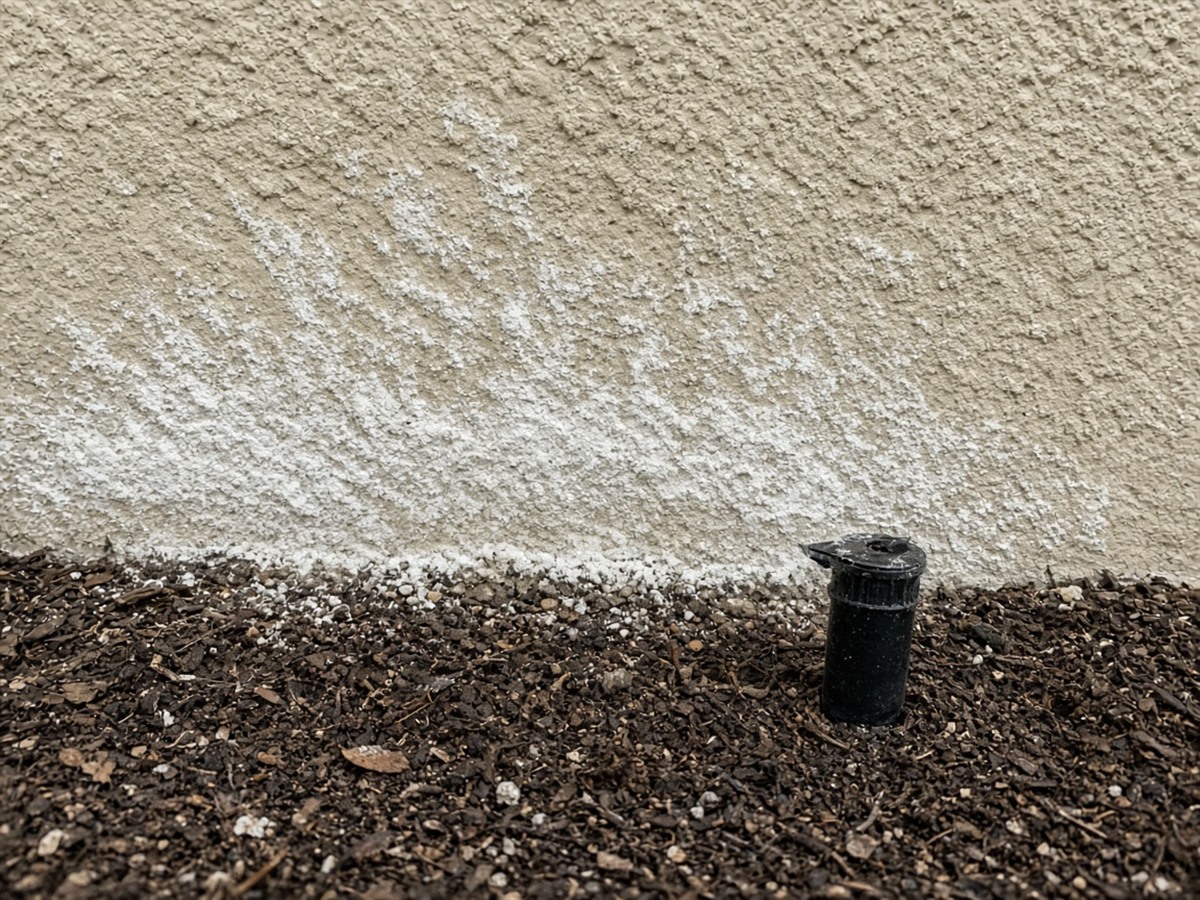
Many Tampa houses are stucco over concrete block. The block and the cement both pass water. The powder on the face is the salt that water carried out. Finding the powder does not, by itself, mean the block is failing. It means water had a path and then the wall dried.

The powder can come back on the same spot if the water still has a path. Washing the dust off does not close that path.
Powder, mildew, and chalk
The three marks get mixed up because all three can look pale on a dull wall.
Efflorescence is dry and dusty. It sits on the cement, often where water has a route, and it brushes off as mineral dust. It is common low on the wall, at a sprinkler line, and under a downspout.
Mildew is a stain. It likes the north wall and the band under the eaves, where the sun does not dry the surface. It smears. It does not brush off as white dust.
Chalk is the paint itself failing. Rub a south or west wall in the afternoon. If the color comes off on your hand, the film is dead. That is sun, not salt. Best exterior paint for Florida stucco is the product choice after the wall is clean. This note is only the powder.

How the salts come off before paint
A coating stuck to salt lets go. The powder is a layer between the cement and the film, so the new paint peels in the same patch. The salts have to come off in the wash, and the wall has to dry, before a patch or a color goes on.
The wash takes the dust. The wall is left until it is dry to the touch and the color of the bare cement looks even. A wall that is still dark from the wash stays unpainted that day. The dry time and the order of the coats are in Preparing Stucco for Painting in Tampa.
If a moderate crack sits in the same patch, the fill waits until the salts are gone. Patch compound on top of powder does not hold any better than paint does. The crack widths, and which lines are a paint-day seal, are in Hairline Cracks in Stucco.
The water still has to be dealt with
Move the sprinkler so the heads do not hit the stucco. A head that soaks the base every morning will put the powder back on that stripe.
A downspout that dumps on the slab, or into a bed tight against the wall, keeps the bottom course wet. Extend it so the water leaves the foundation. A bed that holds mulch against the cement does the same thing as a bad downspout. Pull the mulch back so the base can dry.

If that water keeps coming through, the powder returns and the new film fails in the same place. Nobody can promise the powder will stay gone while the wall is still getting soaked. Washing it once, then painting, does not fix a sprinkler that is still aimed at the wall.
A crack in the same area
A hairline in the powder patch is a different mark. The dust is salt. The line is a crack. Both can be on one elevation, and both have to be handled before color, but they are not the same step. How to read that line, and when a crack is too wide for a paint day, is in Is Painting Over Stucco a Good Idea in Westchase?.
The coating, after the wall is clean and dry, is stucco painting.
Westchase Painting Company checks this powder on walks in Westchase, Citrus Park, Carrollwood, and Town N Country. The shop is on Huntfield Street. Call (813) 320-8710.