Hyde Park holds the distinction of being Tampa's most celebrated historic neighborhood, formally designated as a local historic district in 1985 and listed on the National Register of Historic Places. Spanning roughly from Swann Avenue south to Bayshore Boulevard and from Rome Avenue east to the Hillsborough River, this 160-acre district contains over 600 structures representing nearly every significant American residential architectural style from 1886 through the 1940s. Painting a Hyde Park home isn't just maintenance, it's stewardship of Tampa's architectural heritage. Westchase Painting brings the expertise, patience, and respect these exceptional properties demand.
Why Does Hyde Park Require Historic Painting Specialists?
Painting a home in Hyde Park's historic district is fundamentally different from painting a standard suburban house. The Tampa Historic Preservation Commission (HPC) maintains oversight of exterior alterations to contributing structures within the district, which means color changes on historically significant homes may require a Certificate of Appropriateness before work begins. Our team has guided dozens of Hyde Park homeowners through this process, helping them select period-appropriate color palettes that satisfy both personal taste and preservation standards.
Beyond regulatory requirements, Hyde Park homes present technical challenges that demand specialized knowledge. Many of these structures feature original wood siding, including clapboard, tongue-and-groove, and board-and-batten. that has been painted and repainted dozens of times over 80 to 130 years. Building up layers of paint creates adhesion problems, alligatoring, and thickness issues that require careful assessment. Sometimes selective stripping is necessary; other times, proper preparation of existing surfaces allows for successful overcoating. Making the right call requires experience that only comes from working extensively with historic properties.
The economic stakes are significant. Hyde Park home values are among the highest in Tampa, with properties on streets like Swann Avenue, South Boulevard, and Bayshore Boulevard commanding $800,000 to $3 million or more. A poorly executed paint job doesn't just look bad. it can actively damage century-old substrates and reduce property value. Conversely, a properly executed historic painting project enhances curb appeal, protects irreplaceable materials, and can increase marketability by 5–8% according to National Trust for Historic Preservation research.
What Architectural Styles Define Hyde Park's Character?
Hyde Park's architectural diversity is what makes it extraordinary, and what makes painting here so technically demanding. Each style has distinct features requiring specific approaches:
Queen Anne (1890s–1910s): Hyde Park contains some of Tampa's finest Queen Anne residences, characterized by asymmetrical facades, wrap-around porches with turned spindles and decorative brackets, multiple roof lines, patterned shingles in gable fields, and elaborate window surrounds. Painting a Queen Anne home involves 20 to 30 distinct color applications, body color, trim color, accent colors for decorative elements, sash colors for windows, and porch ceiling color (traditionally light blue, known as "haint blue"). A single Queen Anne exterior may require 40 to 60 hours of detail brushwork alone.
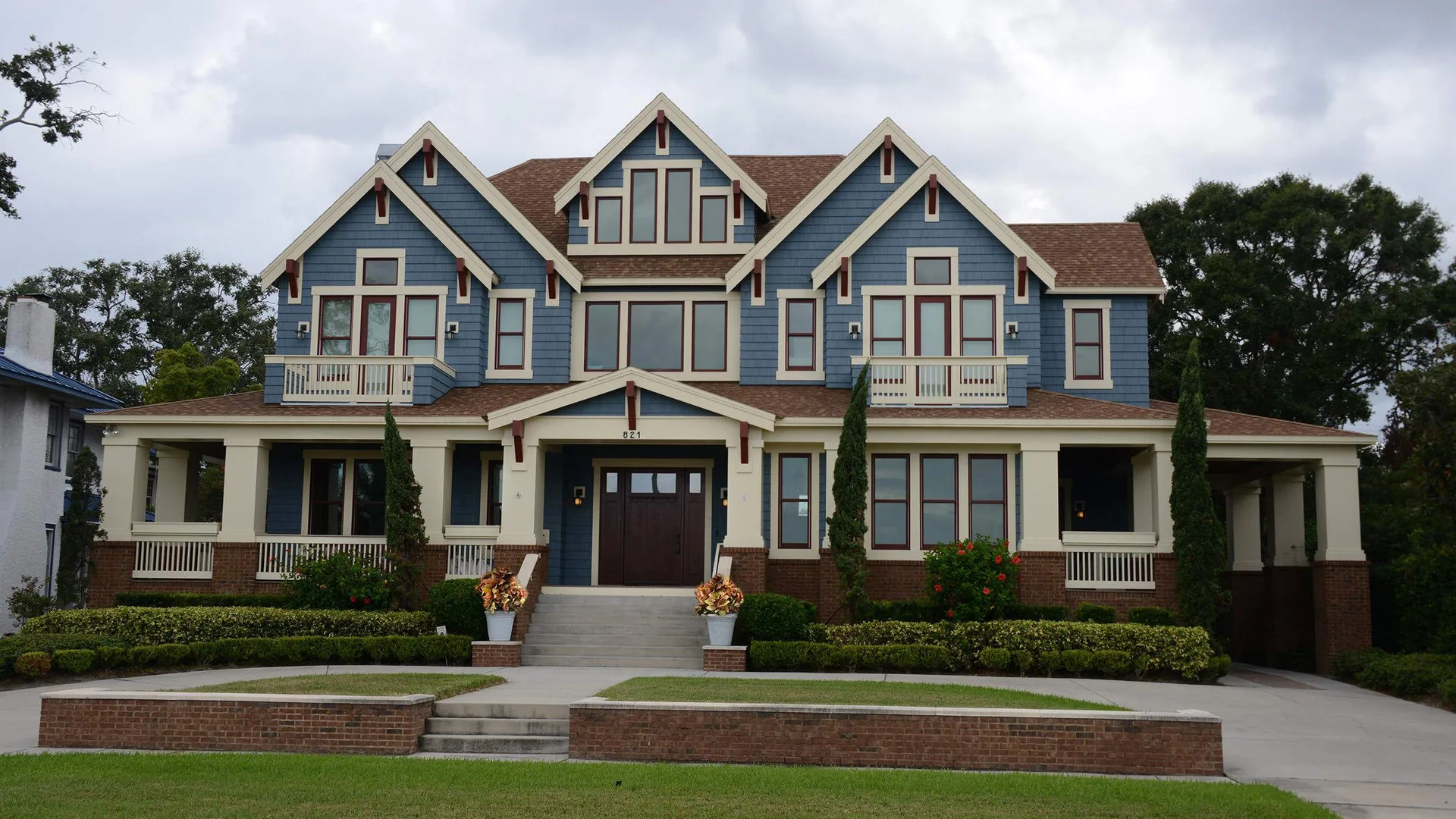
Craftsman Bungalow (1910s–1930s): The most prevalent style in Hyde Park, these homes feature low-pitched roofs with wide overhanging eaves, exposed rafter tails, tapered porch columns on stone or brick piers, and a strong horizontal emphasis. Painting challenges include detailed work on exposed rafter tails (which are structural and vulnerable to moisture), column taper transitions where different materials meet, and stone-to-wood junctions at porch piers. We typically apply 3 to 4 colors on Craftsman exteriors: body, trim, accent (window sash and door), and porch ceiling.
Colonial Revival (1910s–1940s): These symmetrical, dignified homes feature centered front doors with decorative surrounds, multi-pane double-hung windows, columned porticos, and dormers. Paint approaches emphasize crisp trim lines against body colors, flawless column painting (often in white or cream regardless of body color), and careful attention to window muntin bars, which are frequently the most labor-intensive element.
Mediterranean Revival (1920s–1930s): Tampa's building boom brought numerous Mediterranean Revival homes to Hyde Park, featuring stucco walls, barrel tile roofs, arched openings, decorative tile insets, and wrought-iron balconies. These require careful color selection that complements the permanent roof tile color, stucco crack repair before painting, and masking around decorative elements that should not be painted.
Prairie Style (1910s–1920s): A small but significant collection of Prairie-influenced homes exists in Hyde Park, featuring strong horizontal lines, ribbon windows, wide eaves, and restrained ornamentation. These homes demand color choices that emphasize horizontality. typically earth tones with contrasting trim that accentuates the distinctive banded window compositions.
How Does the Historic Preservation Process Affect Painting in Hyde Park?
Understanding Tampa's historic preservation framework is essential before starting any exterior painting project in Hyde Park. Here's how the process works:
The Tampa Historic Preservation Commission classifies structures within the district as either "contributing" (historically significant, built during the district's period of significance) or "non-contributing" (newer construction or significantly altered buildings). Contributing structures face stricter review requirements for exterior changes.
For contributing structures, changing exterior paint colors requires filing a Certificate of Appropriateness (COA) application. Staff-level approval (faster, typically 2–3 weeks) is available for color changes that follow the district's design guidelines. Full commission review (monthly meetings) may be required for unusual proposals. Repainting in the same existing colors does not require a COA.
Non-contributing structures have more flexibility but are still encouraged to select colors compatible with the district's character. Our complimentary color consultation for Hyde Park properties includes guidance on colors that will sail through the approval process while giving you a distinctive, personalized look.
We maintain a library of approved historic color palettes from Sherwin-Williams' Historic Collection and Farrow & Ball's Archive Collection specifically for Hyde Park consultations. These palettes are pre-vetted to align with preservation guidelines, streamlining the approval process for our clients.
What Are Typical Painting Costs for Hyde Park Historic Homes?
Historic home painting in Hyde Park commands premium pricing due to the specialized skills, additional preparation time, and careful techniques required. Our 2025–2026 pricing for this neighborhood:
- Craftsman Bungalow exterior (1,200–1,800 sq ft): $8,000 – $15,000. Includes detailed prep of exposed wood elements, multi-color application, and period-appropriate finishes
- Queen Anne exterior (2,000–3,500 sq ft): $14,000 – $28,000. Complex multi-color schemes with extensive decorative detail work
- Colonial Revival exterior (2,000–3,000 sq ft): $10,000 – $20,000. Precise trim work with emphasis on column and window detail
- Mediterranean Revival exterior (1,800–3,000 sq ft): $9,000 – $18,000. Stucco preparation, crack repair, and salt-resistant coatings
- Interior painting (any style, 1,500–2,500 sq ft): $7,000 – $14,000. Careful work around original millwork, built-ins, and period details
- Interior painting (2,500–4,000 sq ft): $12,000 – $22,000. Larger homes with high ceilings, extensive trim, and specialty rooms
- Cabinet refinishing: $4,500 – $9,500. Kitchen cabinet painting with proper preparation for lasting adhesion
Lead paint assessment and EPA-certified abatement, when required for pre-1978 homes, adds approximately $1,500 to $4,000 depending on the scope. We provide transparent pricing breakdowns so you understand exactly what's included.
What Unique Painting Challenges Do Hyde Park Homeowners Face?
Multi-layer paint buildup: A 100-year-old Hyde Park home may have 15 to 25 layers of paint on exterior surfaces. This accumulated thickness can cause cracking, peeling, and poor adhesion of new coatings. Our assessment determines whether full stripping, selective stripping, or chemical treatment is the most appropriate and cost-effective approach for each surface.
Lead paint management: Any home built before 1978 may contain lead-based paint. In Hyde Park, where most contributing structures predate this threshold, lead paint is virtually guaranteed on original surfaces. Our EPA RRP-certified teams follow strict protocols: HEPA-filtered containment, wet methods to minimize dust, proper waste disposal, and post-project clearance testing when required.
Wood substrate deterioration: Original wood siding, trim, window sills, and porch elements on Hyde Park homes are 80 to 130 years old. Before painting, we conduct detailed wood assessments to identify rot, termite damage, and moisture infiltration. Minor deterioration is repaired with two-part epoxy wood consolidants and fillers. Severely damaged sections are replaced with matching wood profiles, maintaining the historic integrity of the structure.
Mature landscape navigation: Hyde Park's century-old live oaks, dense tropical plantings, and historic brick walkways require careful protection during painting projects. We use covered scaffold systems rather than leaning ladders, protect root zones and bark from equipment damage, and shield garden beds with breathable fabric covers rather than plastic that can trap heat and harm plants.
What Other Areas Near Hyde Park Do You Serve?
Our South Tampa service area encompasses the neighborhoods surrounding Hyde Park:
- Bayshore Beautiful. Waterfront homes along Bayshore Boulevard, immediately south of Hyde Park
- Palma Ceia. Distinguished neighborhood centered around the historic Palma Ceia Golf & Country Club
- Davis Islands. Exclusive island community with 1920s Mediterranean architecture
- South Tampa. Complete South Tampa coverage from Kennedy Blvd to Gandy
- Seminole Heights. Another historic Tampa neighborhood with bungalow-era homes
We serve all of Hillsborough County including Westchase, Carrollwood, and beyond. See our full service area list.
Frequently Asked Questions About Hyde Park Painting
Do I need a permit to paint my Hyde Park historic home?
If your home is a "contributing structure" in the Hyde Park Historic District and you plan to change exterior colors, you will need a Certificate of Appropriateness from the Tampa Historic Preservation Commission. Repainting in the same colors does not require approval. Non-contributing structures and interior painting have no restrictions. We help clients determine their property's status and navigate the approval process at no additional charge.
How do you handle the different wood types found in Hyde Park homes?
Hyde Park homes feature original heart pine, cypress, and old-growth cedar, woods that are no longer commercially available. Each species responds differently to paint systems. Heart pine, for example, is extremely dense and requires specific primer formulations for proper adhesion. Cypress contains natural oils that can bleed through paint if not properly sealed. We identify wood species during our assessment and select appropriate primer and paint systems for each.
Can you restore decorative exterior elements like fish-scale shingles and spindles?
Yes. Ornamental elements are what give Hyde Park homes their character, and restoring them is one of our specialties. We carefully prep, repair, and hand-paint decorative shingles, porch spindles, bracket details, and other ornamental woodwork. For severely deteriorated elements, we can source reproduction millwork from specialty suppliers that match original profiles.
What is "haint blue" and should my Hyde Park porch ceiling be painted this color?
"Haint blue" is a traditional Southern porch ceiling paint color. a soft blue-green that has been used on porch ceilings throughout the South for over 200 years. The tradition originated from Gullah Geechee culture with the belief that the blue color mimics water and discourages spirits (haints) from entering the home. Practically, the light blue color also extends the appearance of daylight on covered porches. Many Hyde Park homeowners choose to honor this tradition, and we carry several historically appropriate haint blue shades.
How long does a full Hyde Park exterior repaint take?
Due to the extensive preparation and detailed work required, Hyde Park exterior projects typically take 8 to 15 working days for a standard Craftsman bungalow and 12 to 20 working days for larger Queen Anne or Colonial homes. This timeline includes thorough preparation (which represents 50–60% of total project time for historic homes), primer application, and two finish coats with detailed brushwork on all architectural elements.
Do you carry insurance appropriate for working on high-value historic homes?
Yes. Westchase Painting maintains comprehensive general liability insurance appropriate for projects in Hyde Parkgeneral liability insurance and workers' compensation coverage appropriate for projects in Hyde Park's price rangeapos;s price range. We are certified and insured, and we provide certificates of insurance upon request. Our coverage specifically addresses the elevated property values and replacement costs associated with historic homes and their irreplaceable architectural elements.
Request Your Free Hyde Park Painting Estimate
Whether your Hyde Park home is a 1905 Queen Anne needing its first professional repaint in decades or a recently renovated Craftsman ready for a fresh color palette, we bring the specialized expertise this district demands. Call (813) 320-8710 or fill out the form below for your complimentary, no-obligation estimate. We'll schedule an in-person evaluation at your convenience and walk through every aspect of your project together.
Hyde Park Painting Guides
Explore our in-depth guides written specifically for Hyde Park homeowners. Each guide covers local architectural styles, climate considerations, cost estimates, and expert recommendations.
Interior Painting in Hyde Park
Room-by-room guidance, color recommendations, and cost estimates tailored to local home styles.
Read full guideExterior Painting in Hyde Park
Climate-specific prep, paint selection, and protection strategies for lasting curb appeal.
Read full guideCabinet Refinishing in Hyde Park
Kitchen transformation options, finish comparisons, and pricing for professional cabinet work.
Read full guide