
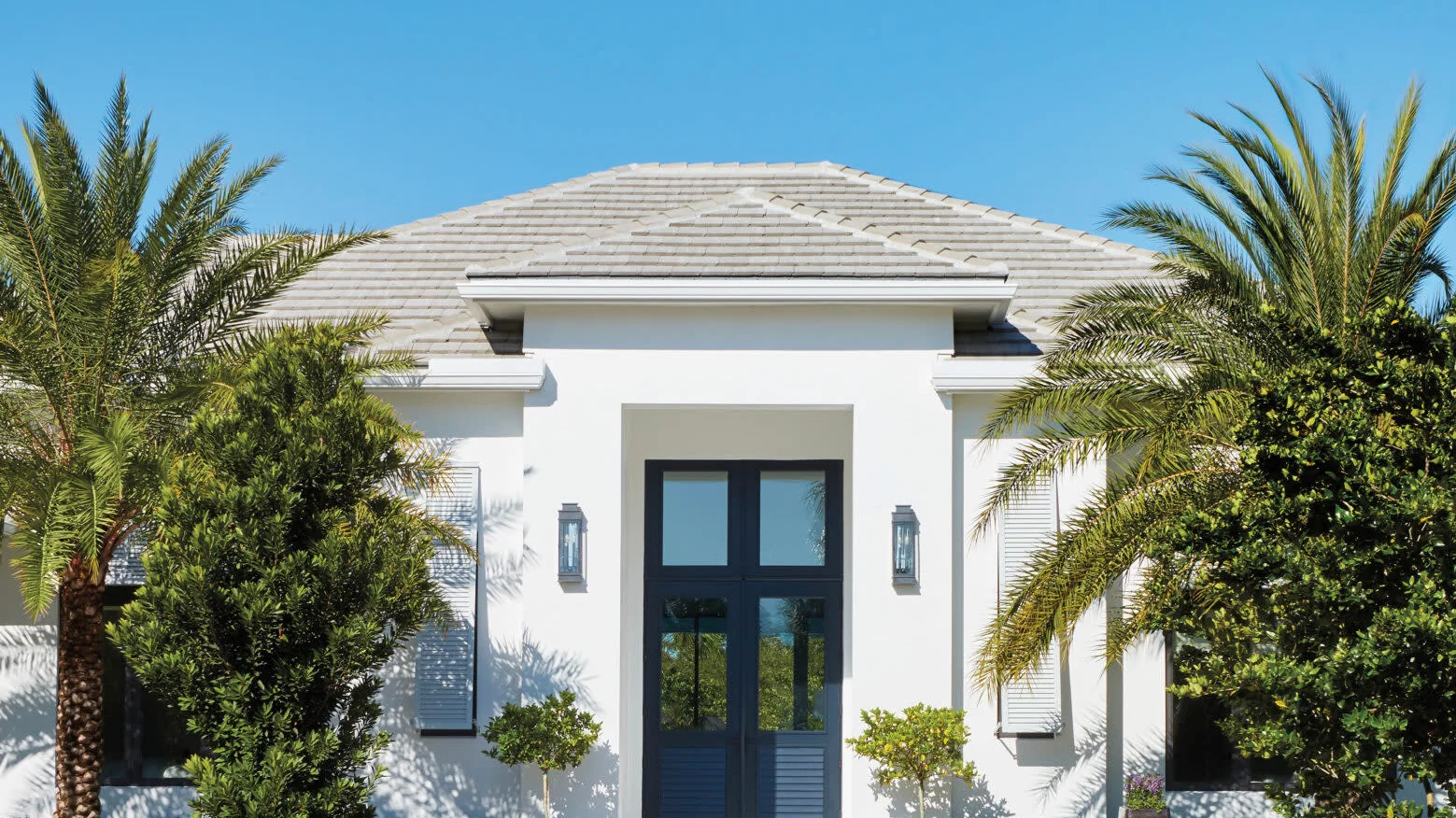

Choosing an exterior paint color in Florida is a different game than choosing one in Virginia or Colorado. The subtropical sun, relentless humidity, afternoon thunderstorms, and salt-laden air all punish certain colors and reward others. Below: the specific colors that perform in Florida’s climate, the technical factors most homeowners overlook, and the palettes that work on Tampa Bay’s stucco homes. (For a deeper look at paint product selection and surface prep for Florida exteriors, see our companion post on choosing exterior paint for Florida’s climate.)
Why Florida Exterior Color Selection Is Different
The color that looks perfect on a paint chip inside your kitchen will look different on your house. In Florida, it will look very different. Four reasons:
Intense sunlight washes colors out. Florida averages 230+ sunny days per year. That direct UV exposure makes every color appear 2-3 shades lighter on your exterior wall than it does on a swatch card indoors. This is the single most common mistake homeowners make: choosing a color under interior lighting, then being surprised when it reads almost white on the house. Always test a 2x2-foot sample on actual stucco, in direct sunlight, at multiple times of day before committing.
Dark colors absorb punishing heat. A dark charcoal or navy exterior in Tampa doesn’t look dramatic. It looks like a heating bill. Exterior surface temperatures on dark-painted stucco can exceed 160°F in direct summer sun. Research from the Florida Solar Energy Center at UCF shows that high-reflectivity exterior surfaces on single-family homes can meaningfully reduce cooling load. Their studies documented savings ranging from 6% to over 20% depending on the specific application and home construction. On a $250/month summer electric bill in Tampa, even the conservative end of that range adds up fast.
Humidity accelerates fading and mold. Tampa Bay’s average relative humidity hovers around 74%. That persistent moisture, combined with UV exposure, breaks down paint pigments faster than in drier climates. Deep reds, saturated blues, and highly chromatic yellows fade fastest. Earth tones, whites, and muted greens hold their color significantly longer.
Stucco is the dominant substrate. Unlike the wood siding common up north, most Tampa Bay homes have stucco exteriors. Stucco is porous, textured, and alkaline. It demands breathable paint formulations (acrylic latex, not oil-based) and shows color differently than smooth wood or vinyl. The texture catches light at multiple angles, which softens and lightens the apparent color even further.
The Technical Factor Most People Ignore: Light Reflectance Value
Every paint color has a Light Reflectance Value (LRV) on a scale of 0 (pure black, absorbs all light) to 100 (pure white, reflects all light). In Florida, LRV matters for three practical reasons: energy efficiency, fade resistance, and long-term appearance.
For body/wall colors, aim for LRV 55-80. Colors in this range reflect enough solar energy to keep your walls and interior cooler, resist UV-driven fading, and maintain their intended appearance for years without turning into a washed-out ghost of what you picked.
For trim and accents, you can go lower (LRV 25-55) because these elements cover less surface area, so the heat absorption is minimal and the visual contrast anchors the whole composition.
Here’s a reference for some popular Florida colors and their LRVs:
| Color | Brand | LRV | Character |
|---|---|---|---|
| White Dove OC-17 | Benjamin Moore | 83 | Clean, warm white. Not stark. |
| Greek Villa SW 7551 | Sherwin-Williams | 84 | Creamy white with warmth. Classic Florida stucco. |
| Sea Salt SW 6204 | Sherwin-Williams | 63 | Pale gray-green. Coastal without being “beachy.” |
| Accessible Beige SW 7036 | Sherwin-Williams | 58 | Warm greige. The workhorse neutral. |
| Balanced Beige SW 7037 | Sherwin-Williams | 46 | Deeper warm neutral for accent or body on lighter homes. |
| Aegean Olive HC-154 | Benjamin Moore | 24 | Rich olive for shutters and doors. |
2026 Color Trends That Actually Work in Florida
Paint companies release “Color of the Year” picks annually. Some of these translate to Florida exteriors and some belong exclusively on an Instagram mood board. These are the ones that actually translate to Florida exteriors in 2026:
Warm Whites and Creamy Neutrals
This is not a trend. It’s the permanent baseline for Florida exteriors. Warm whites and cream tones dominate Tampa Bay neighborhoods for good reason: they reflect heat, resist visible fading, complement terracotta and concrete tile roofs, and satisfy almost every HOA on earth.
Sherwin-Williams Greek Villa (SW 7551) remains the go-to. It reads warm and inviting without the yellow cast that plagues cheaper white formulations. Pair it with a crisp white trim (Extra White SW 7006) for a clean, traditional look, or with a warm bronze or black for something more contemporary.
Benjamin Moore White Dove (OC-17) is the other heavyweight in this category. Slightly softer and more complex than a straight white, with enough warmth to avoid looking clinical on stucco.
Warm Grays and Greige
Gray has dominated exterior trends for a decade, and in Florida the key is choosing grays with warm undertones. Cool, blue-based grays look sterile under Florida sunlight and clash with the warm tones of terracotta, stone, and the surrounding landscape.
Accessible Beige (SW 7036) is technically a greige (gray-beige), and it is one of the most consistently successful exterior colors in the Tampa Bay market. It pairs with both warm and cool trim colors, photographs well, and holds its character in direct sun without washing out.
Repose Gray (SW 7015) works for homeowners who want something cooler without going full gray. Its LRV of 58 keeps it in the optimal range for Florida efficiency, and the balanced undertone prevents it from reading blue or purple in shifting light conditions.
Sage, Olive, and Muted Greens
Green is having a genuine moment in 2026, and it happens to be one of the most Florida-appropriate color families. Muted greens complement the lush tropical landscaping that defines Tampa Bay properties, they resist the visual fading that plagues brighter hues, and they create a natural, grounded look on stucco.
Sherwin-Williams Quietude (SW 6212) was their 2025 Color of the Year. It’s a soft sage with a blue-green influence that reads calm and sophisticated on a Florida exterior. For homes with tropical landscaping, it creates an organic connection between the structure and the yard.
Dried Thyme (SW 6186) goes deeper and earthier. This is a strong choice for a front door, shutters, or a full-body color on a home with lighter stone or brick accents. It’s a Mediterranean tone that fits Tampa’s architectural heritage naturally.
Coastal Blues and Aqua Tones
You live near the Gulf of Mexico. Blue is always going to feel appropriate here. The key is restraint. Bright, saturated blues fade fast and look cartoonish on stucco. Muted, grayed-out blues with enough white or green in them to push the LRV above 50 are the ones that perform.
Sherwin-Williams Rainwashed (SW 6211) is a soft aqua-gray that captures the coastal aesthetic without screaming “beach house.” It pairs naturally with white trim and a bronze or charcoal front door.
Benjamin Moore Beach Glass (1564) offers a similar feel with slightly more green, making it read almost like a pale seafoam in direct sunlight. On stucco, it has a relaxed, timeless quality.
Bold Accents: Where to Use Deeper Colors
Darker, richer colors belong on your front door, shutters, garage door, and trim accents rather than across 2,000 square feet of sun-blasted stucco. These accent elements get less direct sun exposure and cover less surface area, so fading and heat absorption are manageable.
Benjamin Moore Silhouette (AF-655), their 2026 Color of the Year, is an espresso brown with charcoal depth. On a front door against a warm white or cream body, it creates a grounded, high-contrast entry that photographs beautifully.
Sherwin-Williams Universal Khaki (SW 6150), their 2026 pick, is a warm, earthy neutral that works as either a body color on a medium-toned home or an accent/trim color on a lighter one. Its LRV of 37 puts it in accent territory for most Florida applications.
Iron Ore (SW 7069) is a near-black that’s become the default modern accent for garage doors, front doors, and trim elements. It reads rich and intentional where black would read flat and maintenance-heavy.
Paint Products That Perform in Florida’s Climate
Not all exterior paint is created equal, and Florida’s conditions expose cheap paint within a year. Two product lines are worth the premium:
Sherwin-Williams Emerald Exterior comes with a lifetime limited warranty and is specifically formulated for extreme fade resistance, blistering resistance, and moisture performance. On Florida stucco, it holds color significantly longer than mid-tier alternatives. The self-priming formula saves time and material on surfaces in good condition.
Benjamin Moore Aura Exterior uses their Color Lock Technology, which provides superior fade resistance even in darker shades. This matters if you’re going with a deeper body color or rich accent. Aura also offers excellent adhesion on alkaline substrates like new or recently patched stucco.
Both products perform best in satin or eggshell finishes for Florida exteriors. Flat finishes absorb more UV and show mold and mildew staining sooner. Satin reflects light slightly, resists moisture penetration better, and cleans more easily when Tampa’s summer storms leave dirt streaks on your walls.
Picking Colors for Tampa Bay’s Most Common Home Styles
Traditional Florida Stucco (Most of Westchase, Carrollwood, Citrus Park)
Body: Greek Villa (SW 7551) or Accessible Beige (SW 7036)
Trim: Extra White (SW 7006) or Shoji White (SW 7042)
Front Door: Iron Ore (SW 7069) or Aegean Olive (HC-154)
Shutters (if present): Match the front door or go one shade darker than the body
This combination is clean, timeless, and HOA-safe in virtually every Tampa Bay community.
Coastal/Mediterranean
Body: Sea Salt (SW 6204) or Rainwashed (SW 6211)
Trim: White Dove (OC-17) or Chantilly Lace (OC-65)
Front Door: Silhouette (AF-655) or Naval (SW 6244)
Accents: Warm bronze hardware and light fixtures
This works on homes near the water or with Spanish tile roofing and arched entries.
Modern/Contemporary
Body: Repose Gray (SW 7015) or Mindful Gray (SW 7016)
Trim: Pure White (SW 7005)
Front Door: Iron Ore (SW 7069) or Tricorn Black (SW 6258)
Garage Door: Match body color for a seamless, monolithic look
Clean lines, minimal contrast, and a flat or very low-sheen finish on trim elements.
HOA Color Approval in Westchase and Tampa Bay Communities
If you live in a deed-restricted community (and in the Tampa Bay area, you probably do), color selection isn’t optional. It’s regulated.
Westchase Community Association requires an exterior modification request approved before any painting begins. The community maintains an approved color palette through Sherwin-Williams. We’ve put together a dedicated guide to Westchase HOA painting guidelines with the full process. Your Property Manager can provide the current list. Submit your proposed colors with specific Sherwin-Williams color codes, allow 2-4 weeks for ARC (Architectural Review Committee) review, and do not start work until you have written approval. Starting before approval can result in fines and mandatory repainting at your expense.
Window frames in Westchase must be white, bronze, or match the approved exterior body/trim color. Decorative shutters must be a single color that complements the home’s style and falls within the approved palette.
Most Tampa Bay HOAs follow similar guidelines. The safest approach: pick 2-3 colors from the approved palette, request paint samples from Sherwin-Williams or Benjamin Moore, apply test patches on your actual stucco, photograph them in morning and afternoon light, and submit those specific colors with your modification request.
How to Test Colors Before Committing
Never choose an exterior color from a fan deck alone. The process that produces the best results:
- Narrow to 3-4 candidates based on LRV range, undertone preference, and your roof/hardscape colors
- Get quart samples from your local Sherwin-Williams or Benjamin Moore
- Paint 2x2-foot test patches on your actual exterior stucco, in a spot that gets both morning and afternoon sun
- Live with them for 3-5 days, checking at different times of day and in different weather
- Check at night under your exterior lighting as well, since the entry and front elevation are seen at night too
This $40 investment in sample quarts prevents a $5,000 mistake.
Ready to Transform Your Home’s Exterior?
Westchase Painting Company helps Tampa Bay homeowners choose the right colors and apply them with the products and techniques that Florida’s climate demands. Our color consultation service takes the guesswork out of the process. We use Sherwin-Williams Emerald and Benjamin Moore Aura on our exterior painting projects, and we’ll walk through color selection with you before a single brushstroke hits your walls.
Call (813) 320-8710 or request your free estimate online. We serve Westchase, Carrollwood, Citrus Park, Odessa, Lutz, Land O’ Lakes, South Tampa, and communities throughout the Tampa Bay area.
Related reading: How Much Does It Cost to Paint a House in Westchase? | How Often Should You Repaint Your House in Florida? | Preparing Stucco for Painting in Tampa | Interior Paint Colors: Tampa Bay Guide