
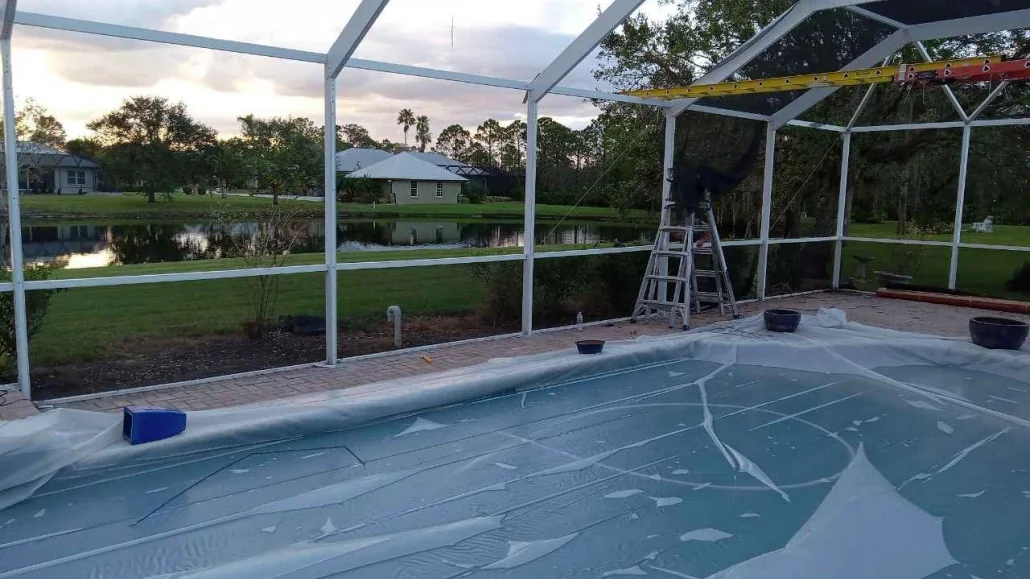

Your pool cage is one of the first things people notice about your home. When oxidation turns those aluminum frames chalky white or dingy gray, the whole backyard looks neglected. A proper pool cage painting restores the structure, protects the metal, and costs a fraction of what full replacement runs. This is everything Tampa Bay homeowners need to know before hiring a painter or picking up a sprayer.
Why Pool Cages Deteriorate in Florida
Florida is brutal on aluminum. Tampa Bay gets over 2,900 hours of direct sunshine per year and logs upwards of 80 thunderstorm days annually according to the National Weather Service Tampa Bay office. That combination of relentless UV exposure, salt-laden humidity, and cyclical wet-dry conditions creates a chemical environment that aggressively attacks unprotected metal.
Three things happen to your pool cage over time:
Oxidation is the most common issue. Aluminum reacts with oxygen and moisture in the air, forming a dull, chalky layer on the surface. Coastal homes and properties near saltwater see this happen faster because chloride ions accelerate the reaction. If you run your hand along an old pool cage frame and get white powder on your fingers, that’s oxidation.
Chalking occurs when UV radiation breaks down the molecular bonds in existing paint or factory finish. The surface becomes powdery and faded. This is why pool cages on the south and west sides of homes (the sides that catch the most afternoon sun) tend to look worse than those facing north or east.
Peeling and flaking happen when paint was applied over a poorly prepared surface, when the wrong primer was used, or when moisture gets trapped underneath the coating. Chlorine off-gassing from pool water and galvanic corrosion at joints where dissimilar metals meet (aluminum touching steel screws, for example) also cause localized paint failure.
None of these problems fix themselves. They compound. And the longer you wait, the more prep work a painter has to do before applying a new coat.
Pool Cage Painting vs. Rescreening vs. Replacement: What Makes Sense?
This is the question every homeowner asks first, and the answer depends on the condition of your structure.
Painting is the right move when the aluminum frame is structurally sound but cosmetically degraded. If the cage stands straight, the joints are tight, and the main issue is appearance and surface corrosion, painting gives you a like-new look at a fraction of the cost.
- Typical cost: $1,800 - $4,500 for a standard residential pool cage
- Timeline: 3-5 days
- Lifespan: 7-10 years with premium materials and proper preparation
Rescreening addresses torn, sagging, or UV-damaged screen panels. If your frames look fine but the mesh is failing, rescreening runs $1,200 - $3,500 depending on screen type and cage size. Many homeowners combine rescreening with painting for a complete restoration.
Full replacement is the nuclear option. You need it when the structure itself is compromised: bent or corroded load-bearing members, foundation issues, or storm damage that twisted the frame. Expect to pay $8,000 - $25,000+ for a new enclosure, with complex or two-story cages running even higher.
When the beams are bent or the footers have moved, paint will not fix the structure. That job is a new pool cage, with a permit and a frame sized for the wind at the address.
Run the numbers yourself. If your cage is structurally sound, painting delivers 80-90% of the visual impact of a brand new enclosure at roughly 15-25% of the cost.
What Kind of Paint Goes on a Pool Cage?
You cannot use house paint on a pool cage. Standard exterior latex will peel within months. The aluminum substrate, constant moisture exposure, and chemical environment around a pool demand specialized coatings.
Direct-to-Metal (DTM) coatings are the industry standard for pool cage painting in Florida. These products are formulated to bond directly to aluminum without a separate primer (though a dedicated primer still improves adhesion and longevity on heavily oxidized surfaces). Sherwin-Williams produces several DTM lines, including their Pro Industrial DTM Acrylic and Bond-Plex coatings, that professional painters in Tampa Bay rely on for pool enclosure work.
Acrylic polyurethane systems offer superior UV stability and color retention. These two-component coatings cure harder than single-component alternatives and resist chalking significantly longer in direct sunlight. They cost more per gallon, but the extended lifespan makes the per-year cost lower.
Epoxy-based primers are used as a base coat on heavily corroded or previously painted cages. Epoxy creates an extremely strong bond to bare aluminum and provides a chemical-resistant foundation for the topcoat.
Application method matters as much as product selection. Pool cage painting is spray-only work. Brushing or rolling cannot achieve the thin, even film thickness that prevents drips, sags, and premature failure on narrow aluminum extrusions. Professional painters use airless or HVLP spray systems with tips sized specifically for the viscosity of DTM coatings.
The Preparation Process (This Is Where Jobs Succeed or Fail)
Surface preparation accounts for roughly 60-70% of the labor on a pool cage painting project. A coating is only as good as what’s underneath it. Cut corners on prep and the paint fails within a year. A proper preparation process includes six stages:
Step 1: Screen Removal and Masking
All screen panels adjacent to the areas being painted are either removed or carefully masked. Paint overspray on screen mesh is nearly impossible to remove without damaging the screen. Most professional crews remove screens in sections, label them, and reinstall after the paint cures.
Step 2: Pressure Washing
The entire structure gets pressure washed at 1,500 - 2,000 PSI. This removes loose oxidation, mold, mildew, dirt, cobwebs, and any chalking paint. The goal is bare, clean metal. Some painters add a mild detergent or sodium hypochlorite solution to the wash to kill mold spores that would otherwise grow under the new paint.
Step 3: Rust Treatment and Spot Repair
Every joint, screw head, and bracket gets inspected. Steel fasteners embedded in aluminum frames are common corrosion points. Rust is treated with a rust converter or mechanically removed with wire brushing. Damaged or corroded hardware is replaced.
Step 4: Sanding and Scuffing
Smooth or glossy surfaces get scuffed with fine-grit sandpaper or abrasive pads. This creates a “tooth” for the new coating to grip. On heavily oxidized cages, the pressure washing alone may create sufficient surface profile, but a good painter checks adhesion in multiple areas before proceeding.
Step 5: Priming (When Necessary)
If the aluminum shows significant bare metal, deep pitting, or heavy corrosion staining, a dedicated epoxy or DTM primer goes down first. On cages in reasonable condition with moderate oxidation, a self-priming DTM topcoat can go directly on the prepared surface.
Step 6: Two-Coat Application
Two thin coats of DTM or polyurethane topcoat are applied by spray, with appropriate dry time between coats. Two thin coats outperform one thick coat in every measurable way: better adhesion, more uniform film thickness, longer lifespan, and better appearance.
How Much Does Pool Cage Painting Cost in Tampa Bay?
Pricing varies based on cage size, height, condition, and accessibility. These are the ranges Tampa Bay homeowners can expect in 2026:
| Factor | Typical Range |
|---|---|
| Standard single-story cage (up to 1,000 sq ft) | $1,800 - $3,000 |
| Large or two-story cage (1,000 - 2,500 sq ft) | $3,000 - $4,500 |
| Extensive corrosion or previous paint removal | Add $500 - $1,500 |
| Combined painting + rescreening | $3,500 - $7,000 |
The biggest cost variable is prep work. A cage that’s never been painted and has moderate oxidation requires less preparation than one with three layers of peeling paint from previous jobs done with the wrong products. When you get an estimate, ask specifically what the preparation process includes. If a company quotes significantly below these ranges, they’re almost certainly skipping steps.
When Should You Paint Your Pool Cage?
Timing matters in Florida. The best conditions for pool cage painting are:
Dry season (October through May) is ideal. Lower humidity means faster cure times, better coating adhesion, and lower risk of rain disrupting a multi-day project. Tampa’s dry season typically sees morning humidity around 55-65%, dropping into the low 50s by afternoon, compared to 75%+ during the summer wet season.
Avoid the summer rainy season (June through September). Tampa averages afternoon thunderstorms nearly every day during summer. Most DTM coatings require a minimum recoat window (check your specific product’s TDS) and 24-48 hours before full cure. A surprise downpour on uncured DTM coating means stripping and reapplying that section.
Morning application works best year-round. Painters can apply coats in the morning when temperatures are moderate (75-85°F is ideal for most DTM products) and humidity is at its daily low point. By afternoon, the coating has time to flash off and begin curing before evening dew.
Can You Use Your Pool During a Cage Painting Project?
In most cases, yes, with some restrictions. The pool itself typically stays accessible throughout the project, but specific areas of the cage and surrounding deck may be cordoned off while wet paint is present. Most painters work in sections, completing and allowing each area to cure before moving to the next.
Expect 3-5 days of some level of disruption. You won’t be locked out of your backyard for a week.
HOA Considerations in Westchase and Tampa Bay
If you live in Westchase, Carrollwood, Cheval, or any deed-restricted community in the Tampa Bay area, check your community’s architectural guidelines before scheduling work. We’ve written a full breakdown of Westchase HOA painting guidelines if you want the details. Most HOAs require:
- Modification request form submitted and approved before work begins
- Color approval from the Architectural Review Committee (ARC). Many communities maintain an approved color palette for exterior elements including pool cages
- Contractor documentation such as proof of insurance and licensing
In the Westchase Community Association, exterior modification requests go through the Property Manager. Submit your request with the proposed color selection (bring a paint chip or Sherwin-Williams color code) and allow 2-4 weeks for committee review. Starting work before approval can result in fines and mandatory removal.
Most communities approve earth tones, bronze, dark brown, black, and certain gray shades for pool cage frames. Bright or non-standard colors will likely get rejected.
Signs Your Pool Cage Needs Painting
Not sure if it’s time? Look for these:
- White or gray chalking when you rub the frame. If powder comes off on your hand, the existing finish has broken down.
- Visible rust staining around screws, brackets, or joints. This means steel fasteners are corroding and the corrosion is spreading.
- Peeling or flaking anywhere on the frame. Once peeling starts, it accelerates because moisture gets under the remaining paint.
- Faded or inconsistent color across the structure. UV degradation affects sun-exposed sections first, creating a patchwork appearance.
- It’s been 7-10 years since the cage was last painted or since original construction without painting. Factory finishes on aluminum cages are minimal and not designed for long-term UV protection in Florida.
Why Hire a Professional for Pool Cage Painting?
Pool cage painting is a project where DIY attempts frequently produce results that look worse than doing nothing. The reasons are practical:
Equipment. Proper application requires an airless or HVLP spray system, not rattle cans or a brush. The equipment alone costs $500-$2,000 to purchase or $150-$300/day to rent.
Height. Two-story cages require ladders, scaffolding, or lift equipment. Fall risk on ladder work around pool decks (which are wet and slippery) is a serious safety concern.
Product knowledge. Choosing the wrong coating, applying at the wrong film thickness, or spraying in wrong conditions produces a result that peels within months. Then you’ve wasted the material cost and created a worse surface for the next painter to deal with.
Overspray management. Spray painting near pools, vehicles, neighboring properties, and landscaping requires professional masking technique and equipment. Overspray claims are a real liability.
A professional crew with pool cage experience, proper insurance, and the right equipment turns a multi-weekend DIY headache into a 3-5 day project with a warranty. If your cage also needs exterior painting on the surrounding fascia or stucco work, a single crew can handle both jobs in one mobilization, which saves on setup and staging costs.
Get Your Pool Cage Painted by Tampa Bay’s Trusted Local Team
Westchase Painting Company specializes in pool cage painting throughout Tampa Bay. We use premium DTM coatings, follow a thorough 6-step preparation process, and back every project with our satisfaction guarantee. Whether your cage needs a first-ever coating or a restoration from years of Florida sun and weather, we’ll give you an honest assessment and a fair price.
Call (813) 320-8710 or request your free estimate online to get started. We serve Westchase, Carrollwood, Citrus Park, Odessa, Lutz, Land O’ Lakes, and communities throughout the Tampa Bay area.
Related reading: How Much Does It Cost to Paint a House in Westchase? | How Often Should You Repaint Your House in Florida? | Preparing Stucco for Painting in Tampa